
€ 12,50 € 10,33 excl. BTW
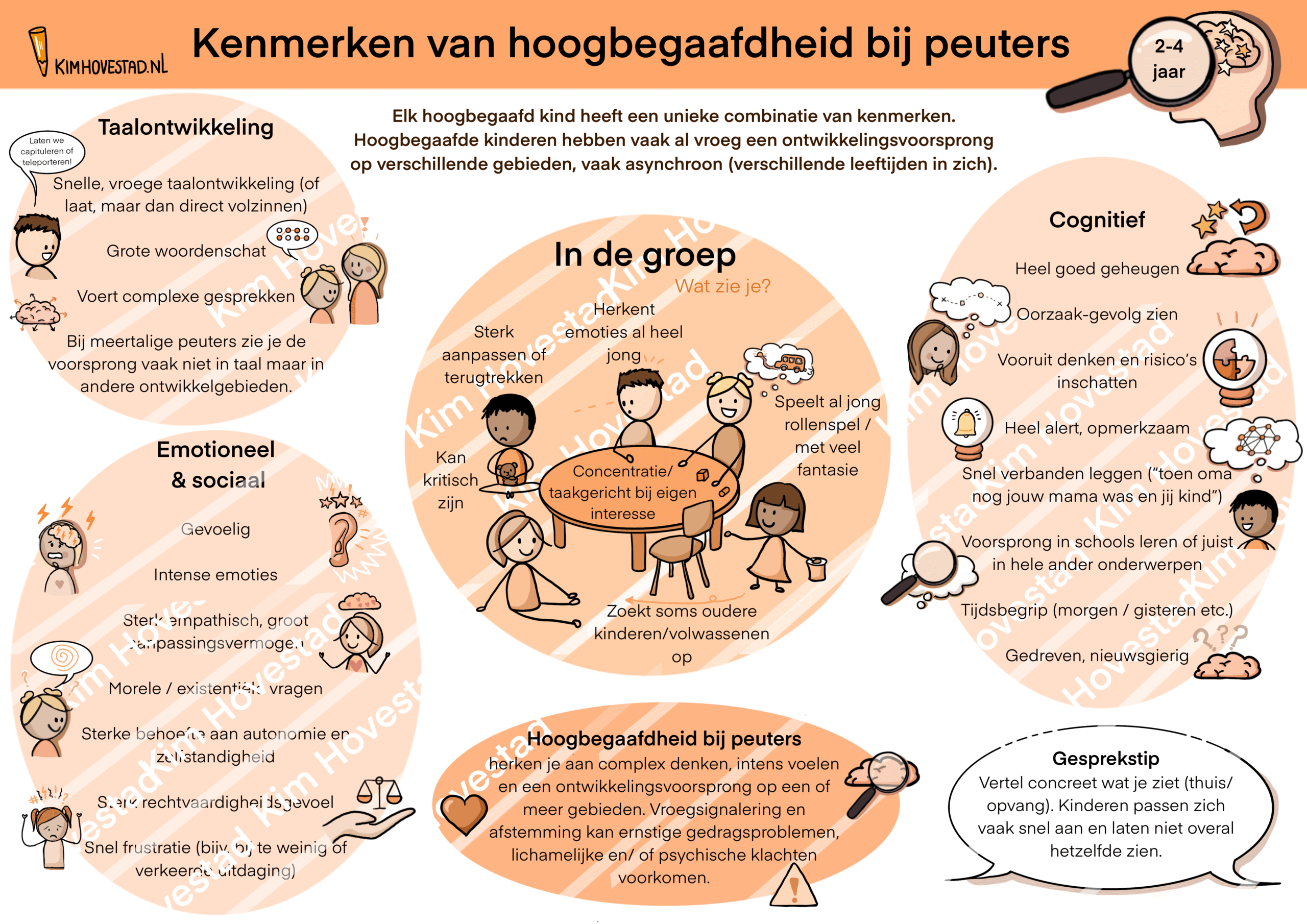
Hoogbegaafde peuters die zich vervelen laten vaak ‘gedrag’ zien: druk, dwars, clownesk, teruggetrokken, koppig.
Als je dit niet herkent als een hoogbegaafd kind dat uitdaging tekort komt, krijg je een verkeerde pedagogische aanpak.
Gevolg: het zelfbeeld kantelt richting ‘lastig kind’ in plaats van ‘kind met behoefte aan meer diepgang’.
Veel ouders horen: “Laat hem maar peuter zijn, rem maar een beetje af.”
Wetenschappelijk gezien is dit juist funest voor de ontwikkeling van hoogbegaafde kinderen.
Wanneer je te laat bent met het signaleren van hoogbegaafdheid, kunnen ernstige klachten ontstaan. Angststoornissen, faalangst, depressie, burn-out achtige klachten bij kinderen, gedragsproblemen en misdiagnoses, bijvoorbeeld. Vroegsignalering is dus geen luxe, maar noodzaak. Hiermee kun je ernstige problemen voorkomen. Vandaar deze praatplaat, meer kennis hier over bij professionals is van groot belang.
Voor wie is de praatplaat bedoeld?
Deze tool is ontwikkeld voor iedereen die betrokken is bij de begeleiding van (vermoedelijk) hoogbegaafde kinderen:
Direct handig inzetbaar bij:
Voor wie is de praatplaat bedoeld?
Deze tekening is gemaakt voor iedereen die betrokken is bij de begeleiding van (vermoedelijk) hoogbegaafde kinderen:
Waarom werkt het?
Geen lange rapporten of vaag beleid, maar een praktisch en visueel hulpmiddel dat het gesprek direct op scherp zet. De praatplaat is ontwikkeld op basis van wetenschappelijke bronnen.
Hang de praatplaat op in de klas, gebruik ‘m in je praktijk of leg ‘m op tafel bij een gesprek met bijvoorbeeld de leerkracht van school of je cliënt. Want soms zegt één beeld meer dan honderd woorden. Bestel vandaag nog en maak neurodiversiteit begrijpelijk en bespreekbaar.
Je krijgt de praatplaten die je in deze webshop besteld als digitale download, zodat je ze zelf kunt printen op het gewenste formaat (t/m A0). Je kunt ze dan bijvoorbeeld ook in je PowerPoint gebruiken (voor niet-commercieel gebruik). Je krijgt dus niets per post thuisgestuurd.
Arden, R., & Plomin, R. (2006). Sex differences in variance of intelligence across childhood. Personality and Individual Differences, 41(1), 39–48.
Barbey, A. K. (2018). Network neuroscience theory of human intelligence. Trends in Cognitive Sciences, 22(1), 8–20.
Beaty, R. E., Benedek, M., Silvia, P. J., & Schacter, D. L. (2016). Creative cognition and brain network dynamics. Trends in Cognitive Sciences, 20(2), 87–95.
Cornoldi, C., Giofrè, D., & Toffalini, E. (2023). Cognitive characteristics of gifted children. Journal of Intelligence, 11(2), 1–18.
Csikszentmihalyi, M. (1990). Flow: The psychology of optimal experience. Harper & Row.
Dabrowski, K. (1972). Psychoneurosis is not an illness. Gryf Publications.
Deci, E. L., & Ryan, R. M. (2000). The “what” and “why” of goal pursuits: Human needs and the self-determination of behavior. Psychological Inquiry, 11(4), 227–268.
Delgado-Valencia, L., et al. (2025). The identification of giftedness in children: A systematic review. Education Sciences, 15(8), 1012.
Diamond, A. (2013). Executive functions. Annual Review of Psychology, 64, 135–168.
Fenson, L., et al. (2007). MacArthur-Bates communicative development inventories. Brookes Publishing.
Gagné, F. (2004). Transforming gifts into talents: The DMGT as a developmental theory. High Ability Studies, 15(2), 119–147.
Gross, M. U. M. (2004). Exceptionally gifted children (2nd ed.). Routledge.
Jung, R. E., & Haier, R. J. (2007). The Parieto-Frontal Integration Theory (P-FIT) of intelligence. Behavioral and Brain Sciences, 30(2), 135–154.
Karwowski, M., & Gralewski, J. (2013). Threshold hypothesis: Fact or artifact? Thinking Skills and Creativity, 8, 25–33.
Kroes-Zwama, L. (2023). Giftedness, sensory processing and executive functioning (Master’s thesis).
Kuznetsova, E., et al. (2024). Cognitive and physiological correlates of giftedness. Frontiers in Psychology, 15, 1411981.
Miedijensky, S. (2025). Insights into gifted development: The influence of early experiences on gifted adults. Education Sciences, 15(6), 677.
Miyake, A., & Friedman, N. P. (2012). The nature and organization of executive functions. Current Directions in Psychological Science, 21(1), 8–14.
Mönks, F. J., & Pflüger, R. (2005). Giftedness and gifted education. In R. J. Sternberg & J. E. Davidson (Eds.), Conceptions of giftedness (2nd ed., pp. 345–365). Cambridge University Press.
Neihart, M., Pfeiffer, S. I., & Cross, T. L. (2016). The social and emotional development of gifted children (2nd ed.). Routledge.
Piechowski, M. M. (2006). “Mellow out,” they say. If only I could. Intensities and sensitivities of the young and bright. Yunasa Books.
Rinn, A. N., & Bishop, J. (2015). Gifted adults: A systematic review. Gifted Child Quarterly, 59(4), 213–235.
Robinson, N. M. (2008). The social world of gifted children and youth. In S. Pfeiffer (Ed.), Handbook of giftedness in children (pp. 33–51). Springer.
Russ, S. W. (2014). Pretend play in childhood: Foundation of adult creativity. American Psychological Association.
Shaw, P., et al. (2006). Intellectual ability and cortical development in children and adolescents. Nature, 440(7084), 676–679.
Silverman, L. K. (2002). Asynchronous development. In M. Neihart et al. (Eds.), The social and emotional development of gifted children (pp. 31–40). Prufrock Press.
Silverman, L. K. (2013). Giftedness 101. Springer.
Singer, D. G., & Singer, J. L. (2005). Imagination and play in the electronic age. Harvard University Press.
Subotnik, R. F., Olszewski-Kubilius, P., & Worrell, F. C. (2011). Rethinking giftedness and gifted education. Psychological Science in the Public Interest, 12(1), 3–54.
Terman, L. M. (1925). Genetic studies of genius. Stanford University Press.
Winner, E. (1996). Gifted children: Myths and realities. Basic Books.
Ziegler, A., et al. (2025). Conceptions of giftedness and gifted education: A Q-sort study. Gifted Child Quarterly.