
Hoogsensitiviteit, wat is dat nou eigenlijk? En hoe leg je dit eenvoudig en duidelijk uit?
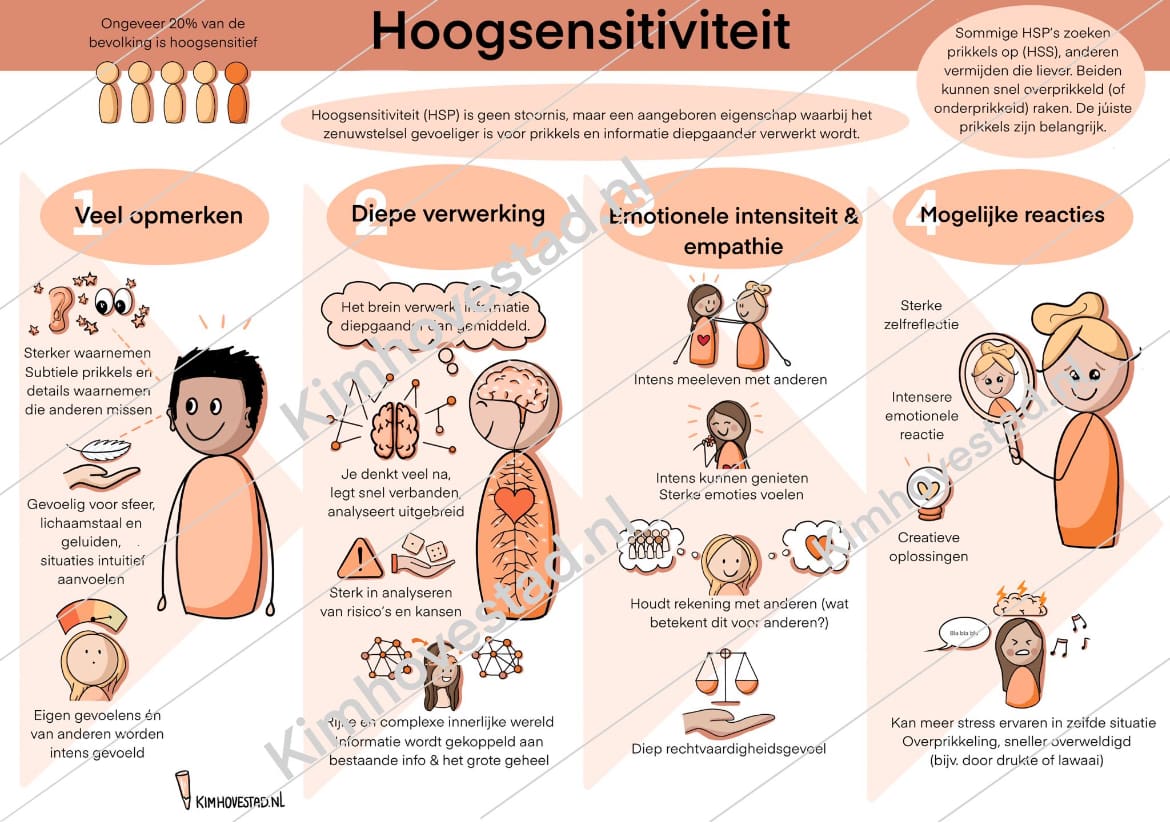
Deze praatplaat maakt in één oogopslag zichtbaar wat hoogsensitiviteit (HSP) is. Hoe het systeem werkt van hoogsensitieve personen.
Hoogsensiviteit, een op de vijf mensen is hoogsensitief. Maar w at is dat nou eigenlijk? Deze praatplaat helpt om dat te begrijpen en uit te leggen.
Met beeld erbij wordt hoogsensitiviteit:
Deze wordt veel gebruikt door:
Omdat je met beeld veel sneller tot de kern komt. Het praat gewoon makkelijker als je samen naar hetzelfde plaatje kijkt.
Al mijn praatplaten zijn ontwikkeld op basis van wetenschappelijke bronnen. Deze visual is gebaseerd op de modellen van Elaine Aron en Esther Bergsma (expert hoogsensitiviteit). Esther leverde ook feedback bij de totstandkoming, evenals Suzanne Nieuwenhuijs-Mekking en Bieke Geenen. Daarmee is de praatplaat stevig onderbouwd en praktisch inzetbaar.
Je ontvangt de praatplaat als digitale download in hoge resolutie. Al mijn producten zijn digitaal. Zo kun je zelf de praatplaat printen, op zowel tasformaat als megaposterformaat! En je kunt hem dan gebruiken in je presentatie (voor niet-commerciële doeleinden). Je kunt de praatplaten gebruiken tijdens gesprekken, en ze ophangen aan de muur bijvoorbeeld. Het is niet toegestaan de praatplaten of de download (uit) te delen. Je krijgt ze digitaal, niet per post.
Extra: Wil jij zelf leren hoe je dit soort praatplaten en visuals tekent? Volg mijn online cursus zakelijk tekenen. Handig voor je werk en heel leuk om te doen!
Acevedo, B. P., Aron, E. N., Aron, A., Sangster, M.-D., Collins, N., & Brown, L. L. (2014). The highly sensitive brain: An fMRI study of sensory processing sensitivity and response to others’ emotions. Brain and Behavior, 4(4), 580-594. https://doi.org/10.1002/brb3.242
Aron, E. N. (1996). The highly sensitive person: How to thrive when the world overwhelms you. Broadway Books.
Aron, E. N., & Aron, A. (1997). Sensory-processing sensitivity and its relation to introversion and emotionality. Journal of Personality and Social Psychology, 73(2), 345-368. https://doi.org/10.1037/0022-3514.73.2.345
Aron, E. N., Aron, A., & Jagiellowicz, J. (2012). Sensory processing sensitivity: A review in the light of the evolution of biological responsivity. Personality and Social Psychology Review, 16(3), 262-282. https://doi.org/10.1177/
Assar, E., Zavos, H. M. S., Krapohl, E., Keers, R., & Pluess, M. (2020). Genetic architecture of environmental sensitivity reflects multiple heritable components: A twin study with adolescents. Molecular Psychiatry. https://doi.org/10.1038/s41380-020-0783-8
Belsky, J., & Pluess, M. (2009). Beyond diathesis stress: Differential susceptibility to environmental influences. Psychological Bulletin, 135(6), 885-908. https://doi.org/10.1037/a0017376
Boyce, W. T., & Ellis, B. J. (2005). Biological sensitivity to context: I. An evolutionary-developmental theory of the origins and functions of stress reactivity. Development and Psychopathology, 17(2), 271-301.
Greven, C. U., Lionetti, F., Booth, C., Aron, E. N., Fox, E., Schendan, H. E., Pluess, M., Bruining, H., Acevedo, B., & Bijttebier, P. (2019). Sensory processing sensitivity in the context of environmental sensitivity: A critical review. Neuroscience & Biobehavioral Reviews, 98, 287-305. https://doi.org/10.1016/j.neubiorev.2019.01.013
Greven, C. U., Trupp, M. D., Homberg, J. R., & Slagter, H. A. (2026). Sensory processing sensitivity: Theory, evidence, and directions. Trends in Cognitive Sciences, 30(6), 530-545. https://doi.org/10.1016/j.tics.2025.10.007
Lionetti, F., Aron, A., Aron, E. N., Burns, G. L., Jagiellowicz, J., & Pluess, M. (2018). Dandelions, tulips and orchids: Evidence for the existence of low-sensitive, medium-sensitive and high-sensitive individuals. Translational Psychiatry, 8, 24. https://doi.org/10.1038/s41398-017-0090-6
Pluess, M. (2015). Individual differences in environmental sensitivity. Child Development Perspectives, 9(3), 138-143. https://doi.org/10.1111/cdep.12120
Pluess, M., Assary, E., Lionetti, F., Lester, K. J., Krapohl, E., Aron, E. N., & Aron, A. (2018). Environmental sensitivity in children: Development of the Highly Sensitive Child Scale and identification of sensitivity groups. Developmental Psychology, 54(1), 51-70. https://doi.org/10.1037/dev0000406
Smolewska, K. A., McCabe, S. B., & Woody, E. Z. (2006). A psychometric evaluation of the Highly Sensitive Person Scale: The components of sensory-processing sensitivity and their relation to the BIS/BAS and “Big Five”. Personality and Individual Differences, 40(6), 1269-1279.
Aron, E. N., & Aron, A. (1997). Sensory-processing sensitivity and its relation to introversion and emotionality. Journal of Personality and Social Psychology, 73(2), 345–368. https://doi.org/10.1037/0022-3514.73.2.345
Greven, C. U., Lionetti, F., Booth, C., Aron, E. N., Fox, E., Schendan, H. E., Pluess, M., Bruining, H., Acevedo, B., & Bijttebier, P. (2019). Sensory processing sensitivity in the context of environmental sensitivity: A critical review. Neuroscience & Biobehavioral Reviews, 98, 287–305. https://doi.org/10.1016/j.neubiorev.2019.01.013
Pluess, M. (2015). Individual differences in environmental sensitivity. Child Development Perspectives, 9(3), 138–143. https://doi.org/10.1111/cdep.12120