
Hoogsensitiviteit, wat is dat nou eigenlijk? En hoe leg je dit eenvoudig en duidelijk uit?
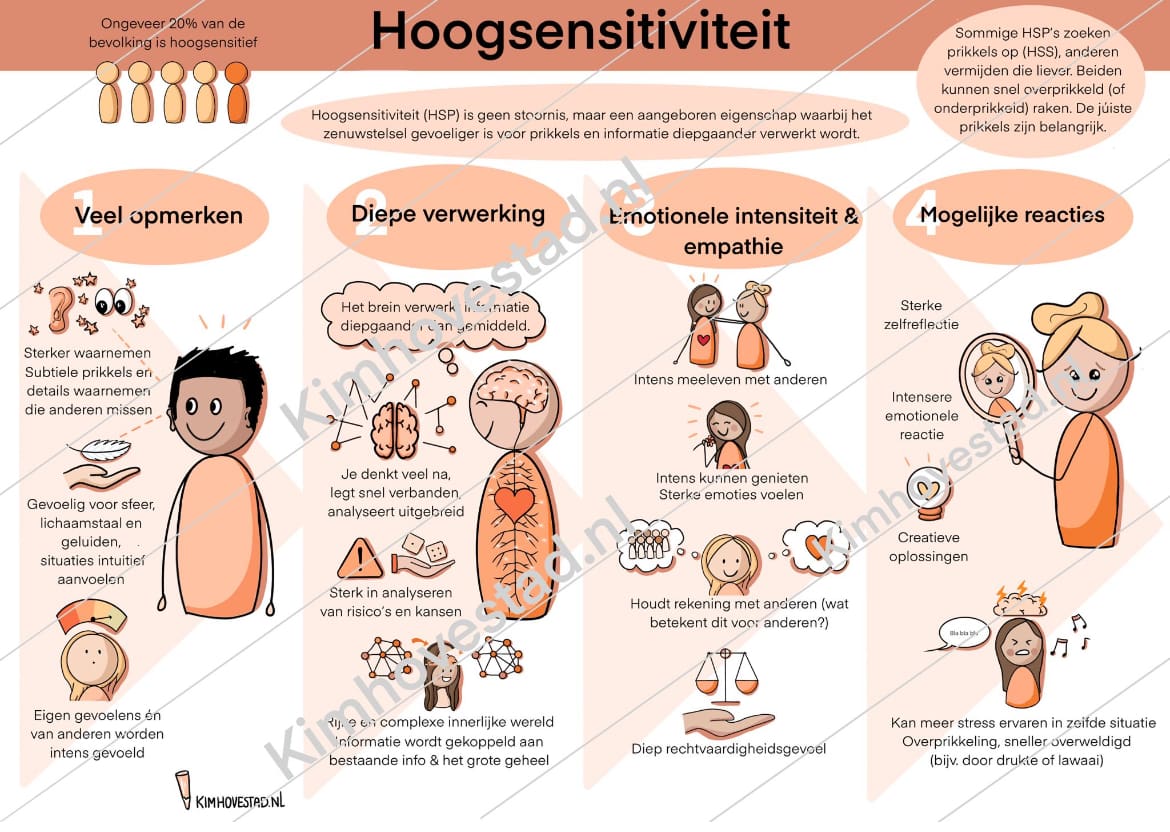
Deze praatplaat maakt in één oogopslag zichtbaar wat hoogsensitiviteit (HSP) is. Hoe het systeem werkt van hoogsensitieve personen.
Hoogsensiviteit, een op de vijf mensen is hoogsensitief. Maar w at is dat nou eigenlijk? Deze praatplaat helpt om dat te begrijpen en uit te leggen.
Met beeld erbij wordt hoogsensitiviteit:
Deze wordt veel gebruikt door:
Omdat je met beeld veel sneller tot de kern komt. Het praat gewoon makkelijker als je samen naar hetzelfde plaatje kijkt.
Al mijn praatplaten zijn ontwikkeld op basis van wetenschappelijke bronnen. Deze visual is gebaseerd op de modellen van Elaine Aron en Esther Bergsma (expert hoogsensitiviteit). Esther leverde ook feedback bij de totstandkoming, evenals Suzanne Nieuwenhuijs-Mekking en Bieke Geenen. Daarmee is de praatplaat stevig onderbouwd en praktisch inzetbaar.
Je ontvangt de praatplaat als digitale download in hoge resolutie. Al mijn producten zijn digitaal. Zo kun je zelf de praatplaat printen, op zowel tasformaat als megaposterformaat! En je kunt hem dan gebruiken in je presentatie (voor niet-commerciële doeleinden). Je kunt de praatplaten gebruiken tijdens gesprekken, en ze ophangen aan de muur bijvoorbeeld. Het is niet toegestaan de praatplaten of de download (uit) te delen. Je krijgt ze digitaal, niet per post.
Extra: Wil jij zelf leren hoe je dit soort praatplaten en visuals tekent? Volg mijn online cursus zakelijk tekenen. Handig voor je werk en heel leuk om te doen!
Rinn, A. N., & Plucker, J. A. (2019). High-ability students: Definitions and identification. Educational Psychology Review, 31(3), 539–561. https://doi.org/10.1007/s10648-019-09467-9
Pfeiffer, S. I. (2018). Handbook of giftedness in children: Psychoeducational theory, research, and best practices (2nd ed.). Springer. https://doi.org/10.1007/978-3-319-77004-8
Subotnik, R. F., Olszewski-Kubilius, P., & Worrell, F. C. (2011). Rethinking giftedness and gifted education. Psychological Science in the Public Interest, 12(1), 3–54. https://doi.org/10.1177/1529100611418056
Ziegler, A., & Stoeger, H. (2017). Systemic gifted education: A theoretical introduction. Roeper Review, 39(1), 3–14. https://doi.org/10.1080/02783193.2016.1247392
McClain, M. C., & Pfeiffer, S. (2012). Identification of gifted students in the United States: A look at state definitions. Journal of Applied School Psychology, 28(4), 369–381. https://doi.org/10.1080/15377903.2012.706253
VanTassel-Baska, J., & Hubbard, G. F. (2016). Classroom-based identification of gifted students. Journal for the Education of the Gifted, 39(3), 189–208. https://doi.org/10.1177/0162353216659377
Renzulli, J. S. (2005). The three-ring conception of giftedness: A developmental model. Gifted Child Quarterly, 49(3), 205–210. https://doi.org/10.1177/001698620504900302
Reis, S. M., & Renzulli, J. S. (2020). The three-ring conception of giftedness revisited. Gifted Child Quarterly, 64(4), 239–251. https://doi.org/10.1177/0016986220941140
Pekrun, R., Lichtenfeld, S., Marsh, H. W., Murayama, K., & Goetz, T. (2017). Achievement emotions and academic performance. Contemporary Educational Psychology, 48, 1–12. https://doi.org/10.1016/j.cedpsych.2016.11.002
Goetz, T., Frenzel, A. C., Hall, N. C., & Pekrun, R. (2008). Academic emotions in the classroom. Journal of Educational Psychology, 100(4), 764–781. https://doi.org/10.1037/0022-0663.100.4.764
Van Tilburg, W. A. P., & Igou, E. R. (2012). On boredom: Lack of challenge and meaning as distinct boredom experiences. Motivation and Emotion, 36(2), 181–194. https://doi.org/10.1007/s11031-011-9234-9
Mann, S., & Robinson, A. (2009). Boredom in the lecture theatre. British Educational Research Journal, 35(2), 243–258. https://doi.org/10.1080/01411920802042911
Sparks, R. C., & Jolly, J. L. (2020). Gifted education: A review of recent research and policy developments. Journal for the Education of the Gifted, 43(4), 345–367.
Gross, M. U. M. (1993). Exceptionally gifted children. Routledge.
Lubinski, D., & Benbow, C. P. (2006). Study of mathematically precocious youth (SMPY): 35-year longitudinal findings. Psychological Science, 17(7), 595–600. https://doi.org/10.1111/j.1467-9280.2006.01744.x
Steenbergen-Hu, S., & Moon, S. M. (2011). The effects of acceleration on high-ability learners: A meta-analysis. Gifted Child Quarterly, 55(1), 39–53. https://doi.org/10.1177/0016986210383155
Kulik, J. A., & Kulik, C. C. (1984). Effects of ability grouping on secondary school students: A meta-analysis. Review of Educational Research, 54(3), 415–427.
Rogers, K. B. (1992). A best-evidence synthesis of research on acceleration options for gifted students. Gifted Child Quarterly, 36(2), 59–69.
Assouline, S. G., Colangelo, N., VanTassel-Baska, J., & Lupkowski-Shoplik, A. (2015). A nation empowered: Evidence trumps the excuses holding back America’s brightest students. Belin-Blank Center.
Steenbergen-Hu, S., Makel, M. C., & Olszewski-Kubilius, P. (2016). What one hundred years of research says about the effects of ability grouping and acceleration. Review of Educational Research, 86(4), 849–899. https://doi.org/10.3102/0034654316675417
National Association for Gifted Children. (2018). Position statement: Acceleration. NAGC.
Aron, E. N., & Aron, A. (1997). Sensory-processing sensitivity and its relation to introversion and emotionality. Journal of Personality and Social Psychology, 73(2), 345–368. https://doi.org/10.1037/0022-3514.73.2.345
Greven, C. U., Lionetti, F., Booth, C., Aron, E. N., Fox, E., Schendan, H. E., Pluess, M., Bruining, H., Acevedo, B., & Bijttebier, P. (2019). Sensory processing sensitivity in the context of environmental sensitivity: A critical review. Neuroscience & Biobehavioral Reviews, 98, 287–305. https://doi.org/10.1016/j.neubiorev.2019.01.013
Pluess, M. (2015). Individual differences in environmental sensitivity. Child Development Perspectives, 9(3), 138–143. https://doi.org/10.1111/cdep.12120