

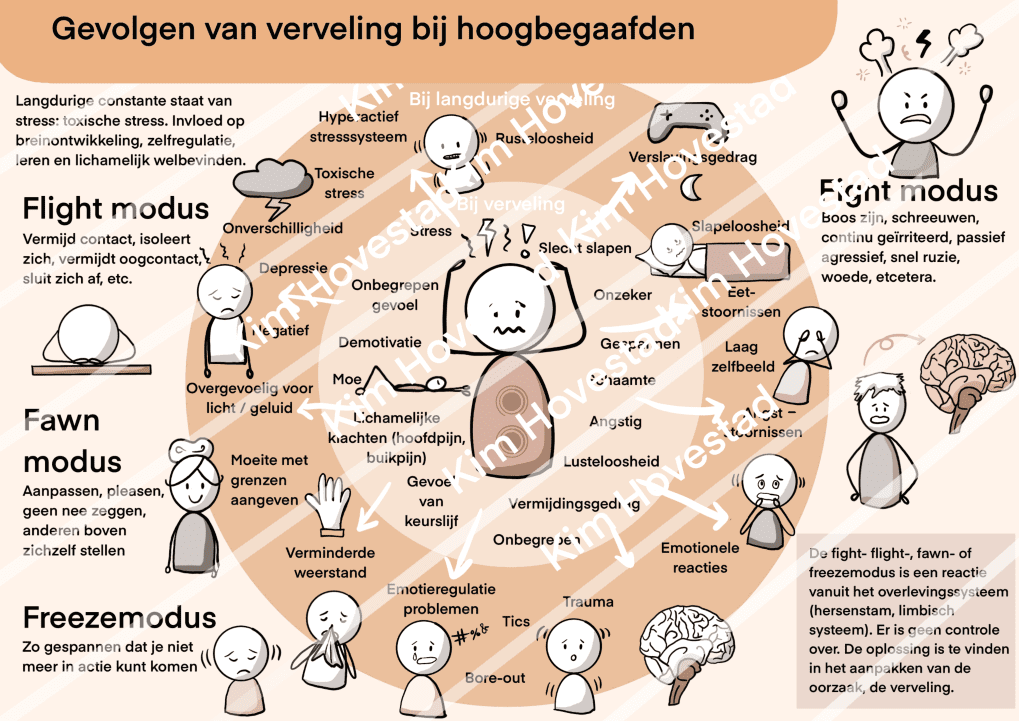
Verveling klinkt onschuldig. Maar het kan echt schadelijk zijn. Hoogbegaafden lopen snel kans zich te vervelen. Chronische verveling of onderprikkeling kan serieuze klachten veroorzaken: fysiek, mentaal en emotioneel. Deze praatplaat laat zien welke klachten kunnen ontstaan bij verveling. Het is voor hoogbegaafde volwassenen van groot belang voor hun gezondheid en welzijn om cognitieve uitdaging te ervaren in hun werk.
Deze visual brengt op een heldere manier in beeld wat er gebeurt als een hoogbegaafd persoon zich langdurig niet cognitief uitgedaagd voelt. Denk aan werk waarin te weinig denkruimte, creativiteit, autonomie of diepgang zit.
Deze poster over verveling bij hoogbegaafden is opgebouwd uit drie ringen:
Deze praatplaat is gebaseerd op wetenschappelijke bronnen over hoogbegaafdheid en stress trauma en onderprikkeling.
Veel hoogbegaafde volwassenen herkennen zich diepgaand in deze plaat. De reacties zijn hartverwarmend én confronterend.
“Gister heb ik deze visual gebruikt tijdens een teamvergadering over hoogbegaafdheid. Het was zó waardevol! Na afloop gaven collega’s aan dat ze bepaalde collega’s nu met heel andere ogen gaan bekijken. Het helpt ze om achter gedrag te leren kijken.” (Marjon, HR manager bij een grote organisatie).
En dát is wat deze praatplaat doet: bewustzijn creëren en gesprekken op gang brengen. Op de werkvloer, in therapie, in het onderwijs of gewoon thuis aan de keukentafel.
Je bestelt de praatplaat als digitale download (A3-formaat).
Na aankoop ontvang je direct het bestand, dat je:
Er is ook een aparte versie van deze praatplaat beschikbaar:
📌 De gevolgen van verveling bij hoogbegaafde kinderen
👉 Ontvang direct je download
👉 Gebruik hem in je werk, training of praktijk
👉 Draag bij aan meer begrip voor hoogbegaafde volwassenen.
Je krijgt de praatplaten die je in deze webshop besteld als digitale download, zodat je ze zelf kunt printen op het gewenste formaat (t/m A0). Je kunt ze dan bijvoorbeeld ook in je PowerPoint gebruiken (voor niet-commercieel gebruik). Je krijgt dus niets per post thuisgestuurd.
Tip: wil je zelf ook leren zakelijk tekenen? Volg mijn online cursus!
Rinn, A. N., & Plucker, J. A. (2019). High-ability students: Definitions and identification. Educational Psychology Review, 31(3), 539–561. https://doi.org/10.1007/s10648-019-09467-9
Pfeiffer, S. I. (2018). Handbook of giftedness in children: Psychoeducational theory, research, and best practices (2nd ed.). Springer. https://doi.org/10.1007/978-3-319-77004-8
Subotnik, R. F., Olszewski-Kubilius, P., & Worrell, F. C. (2011). Rethinking giftedness and gifted education. Psychological Science in the Public Interest, 12(1), 3–54. https://doi.org/10.1177/1529100611418056
Ziegler, A., & Stoeger, H. (2017). Systemic gifted education: A theoretical introduction. Roeper Review, 39(1), 3–14. https://doi.org/10.1080/02783193.2016.1247392
McClain, M. C., & Pfeiffer, S. (2012). Identification of gifted students in the United States: A look at state definitions. Journal of Applied School Psychology, 28(4), 369–381. https://doi.org/10.1080/15377903.2012.706253
VanTassel-Baska, J., & Hubbard, G. F. (2016). Classroom-based identification of gifted students. Journal for the Education of the Gifted, 39(3), 189–208. https://doi.org/10.1177/0162353216659377
Renzulli, J. S. (2005). The three-ring conception of giftedness: A developmental model. Gifted Child Quarterly, 49(3), 205–210. https://doi.org/10.1177/001698620504900302
Reis, S. M., & Renzulli, J. S. (2020). The three-ring conception of giftedness revisited. Gifted Child Quarterly, 64(4), 239–251. https://doi.org/10.1177/0016986220941140
Pekrun, R., Lichtenfeld, S., Marsh, H. W., Murayama, K., & Goetz, T. (2017). Achievement emotions and academic performance. Contemporary Educational Psychology, 48, 1–12. https://doi.org/10.1016/j.cedpsych.2016.11.002
Goetz, T., Frenzel, A. C., Hall, N. C., & Pekrun, R. (2008). Academic emotions in the classroom. Journal of Educational Psychology, 100(4), 764–781. https://doi.org/10.1037/0022-0663.100.4.764
Van Tilburg, W. A. P., & Igou, E. R. (2012). On boredom: Lack of challenge and meaning as distinct boredom experiences. Motivation and Emotion, 36(2), 181–194. https://doi.org/10.1007/s11031-011-9234-9
Mann, S., & Robinson, A. (2009). Boredom in the lecture theatre. British Educational Research Journal, 35(2), 243–258. https://doi.org/10.1080/01411920802042911
Sparks, R. C., & Jolly, J. L. (2020). Gifted education: A review of recent research and policy developments. Journal for the Education of the Gifted, 43(4), 345–367.
Gross, M. U. M. (1993). Exceptionally gifted children. Routledge.
Lubinski, D., & Benbow, C. P. (2006). Study of mathematically precocious youth (SMPY): 35-year longitudinal findings. Psychological Science, 17(7), 595–600. https://doi.org/10.1111/j.1467-9280.2006.01744.x
Steenbergen-Hu, S., & Moon, S. M. (2011). The effects of acceleration on high-ability learners: A meta-analysis. Gifted Child Quarterly, 55(1), 39–53. https://doi.org/10.1177/0016986210383155
Kulik, J. A., & Kulik, C. C. (1984). Effects of ability grouping on secondary school students: A meta-analysis. Review of Educational Research, 54(3), 415–427.
Rogers, K. B. (1992). A best-evidence synthesis of research on acceleration options for gifted students. Gifted Child Quarterly, 36(2), 59–69.
Assouline, S. G., Colangelo, N., VanTassel-Baska, J., & Lupkowski-Shoplik, A. (2015). A nation empowered: Evidence trumps the excuses holding back America’s brightest students. Belin-Blank Center.
Steenbergen-Hu, S., Makel, M. C., & Olszewski-Kubilius, P. (2016). What one hundred years of research says about the effects of ability grouping and acceleration. Review of Educational Research, 86(4), 849–899. https://doi.org/10.3102/0034654316675417
National Association for Gifted Children. (2018). Position statement: Acceleration. NAGC.
Aron, E. N., & Aron, A. (1997). Sensory-processing sensitivity and its relation to introversion and emotionality. Journal of Personality and Social Psychology, 73(2), 345–368. https://doi.org/10.1037/0022-3514.73.2.345
Greven, C. U., Lionetti, F., Booth, C., Aron, E. N., Fox, E., Schendan, H. E., Pluess, M., Bruining, H., Acevedo, B., & Bijttebier, P. (2019). Sensory processing sensitivity in the context of environmental sensitivity: A critical review. Neuroscience & Biobehavioral Reviews, 98, 287–305. https://doi.org/10.1016/j.neubiorev.2019.01.013
Pluess, M. (2015). Individual differences in environmental sensitivity. Child Development Perspectives, 9(3), 138–143. https://doi.org/10.1111/cdep.12120
Dąbrowski, K. (1964). Positive disintegration. Little, Brown.
Piechowski, M. M. (1979). Developmental potential. Review of Educational Research, 49(2), 259–282. https://doi.org/10.3102/00346543049002259
Wirthwein, L., Becker, C. V., Löhr, E.-M., & Rost, D. H. (2011). Overexcitabilities in gifted and non-gifted adults. Personality and Individual Differences, 51(3), 337–342. https://doi.org/10.1016/j.paid.2011.03.041
De Gucht, V., et al. (2022). Sensory Processing Sensitivity Questionnaire (SPSQ) development and validation. Assessment.
Wood, V. R., et al. (2024). Prevalence of overexcitabilities in highly and profoundly gifted children and adolescents. Education Sciences, 14(8), 817. https://doi.org/10.3390/educsci14080817
Samsen-Bronsveld, H. E., Bakx, A. W. E. A., Bogaerts, S., & Van der Ven, S. H. G. (2024). Sensory processing sensitivity in gifted children. Gifted Child Quarterly. https://doi.org/10.1177/00169862241239652
Mendaglio, S. (2015). Overexcitability and the gifted. Royal Fireworks Press.